Speak to Z21
  • Actionable plan on how to grow your online sales
  • Industry-relevant case studies and benchmarks
  • Bounce ideas with our team
  • Enquire about Z21's services
Malaysia

Pizza Hut Malaysia

Services

Customer Data Platform, CRM & Retention

Industry

Quick Service Restaurants

Year

2026
First 6 months post-launch
9 in 10
Of recovered cart revenue arrived through push rather than email
9 in 10
Of recovered cart revenue arrived through push rather than email
Zero
Orders from anonymous profiles, at known-member engagement rates

This is a text when testiominal is not set up.

Lorem ipsum dolor sit amet, consectetur adipiscing elit. Suspendisse varius enim in eros elementum tristique.

Overview

CRO Case Study

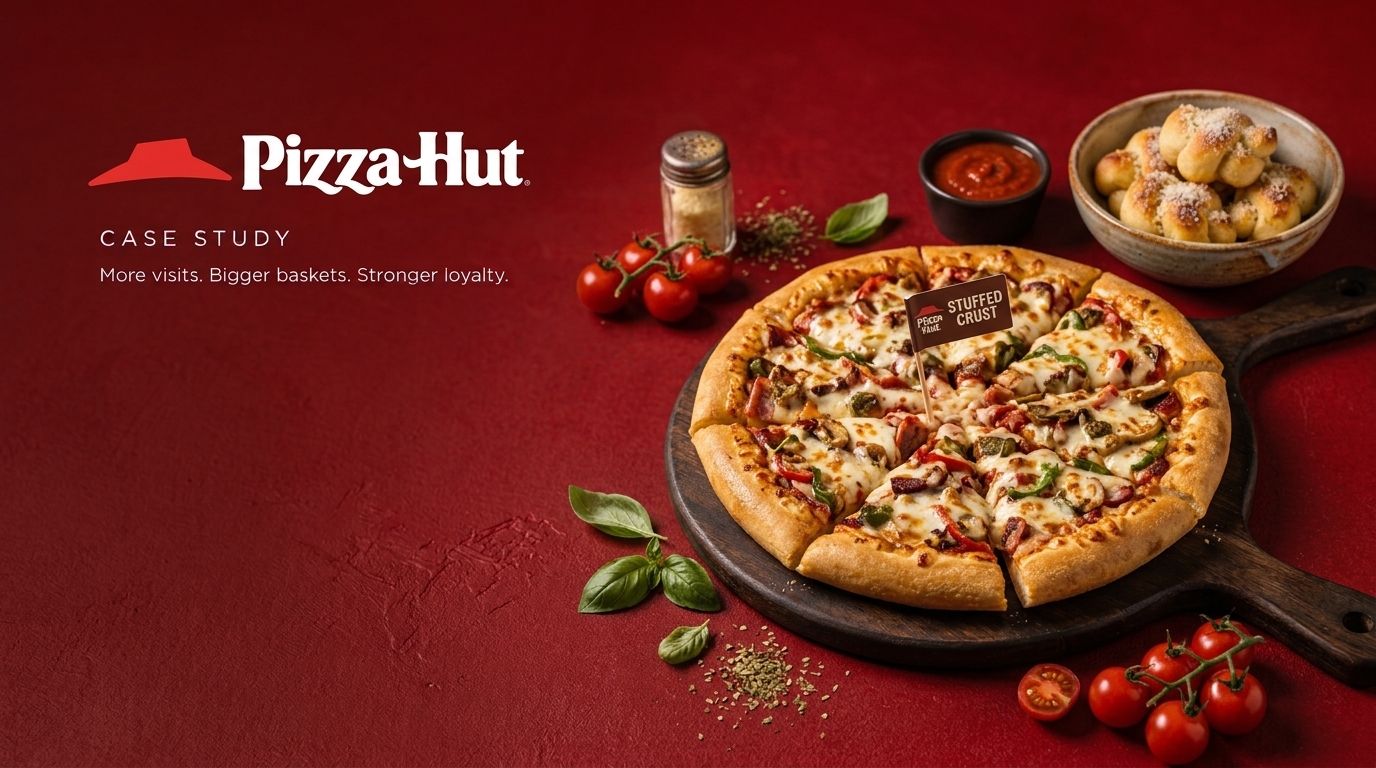
Pizza Hut Malaysia takes orders through its own app and website, and its loyalty programme carries a very large customer base. All of that customer data sat in Netcore, a customer data platform the brand was already running. Convx by Z21 ran the layer above it: lifecycle strategy, segmentation, journey design and creative, with the platform team building to our specification.

No items found.
01
Expand +
Collapse -
+
-
Before
After
Before
After
Before
After

Heading 1

Heading 2

Heading 3

Heading 4

Heading 5
Heading 6

Lorem ipsum dolor sit amet, consectetur adipiscing elit, sed do eiusmod tempor incididunt ut labore et dolore magna aliqua. Ut enim ad minim veniam, quis nostrud exercitation ullamco laboris nisi ut aliquip ex ea commodo consequat. Duis aute irure dolor in reprehenderit in voluptate velit esse cillum dolore eu fugiat nulla pariatur.

Block quote

Ordered list

  1. test Item 1
  2. Item 2
  3. Item 3

Unordered list

  • Item A
  • Item B
  • Item C

Text link

Bold text

Emphasis

Superscript

Subscript

The Challenges

  1. Dormancy meant everything, so it meant nothing

    Every customer who had stopped ordering sat in one segment, whether they had missed a single month or had not ordered in over a year. They all got the same message and the same voucher.
  2. Cart recovery was built for retail

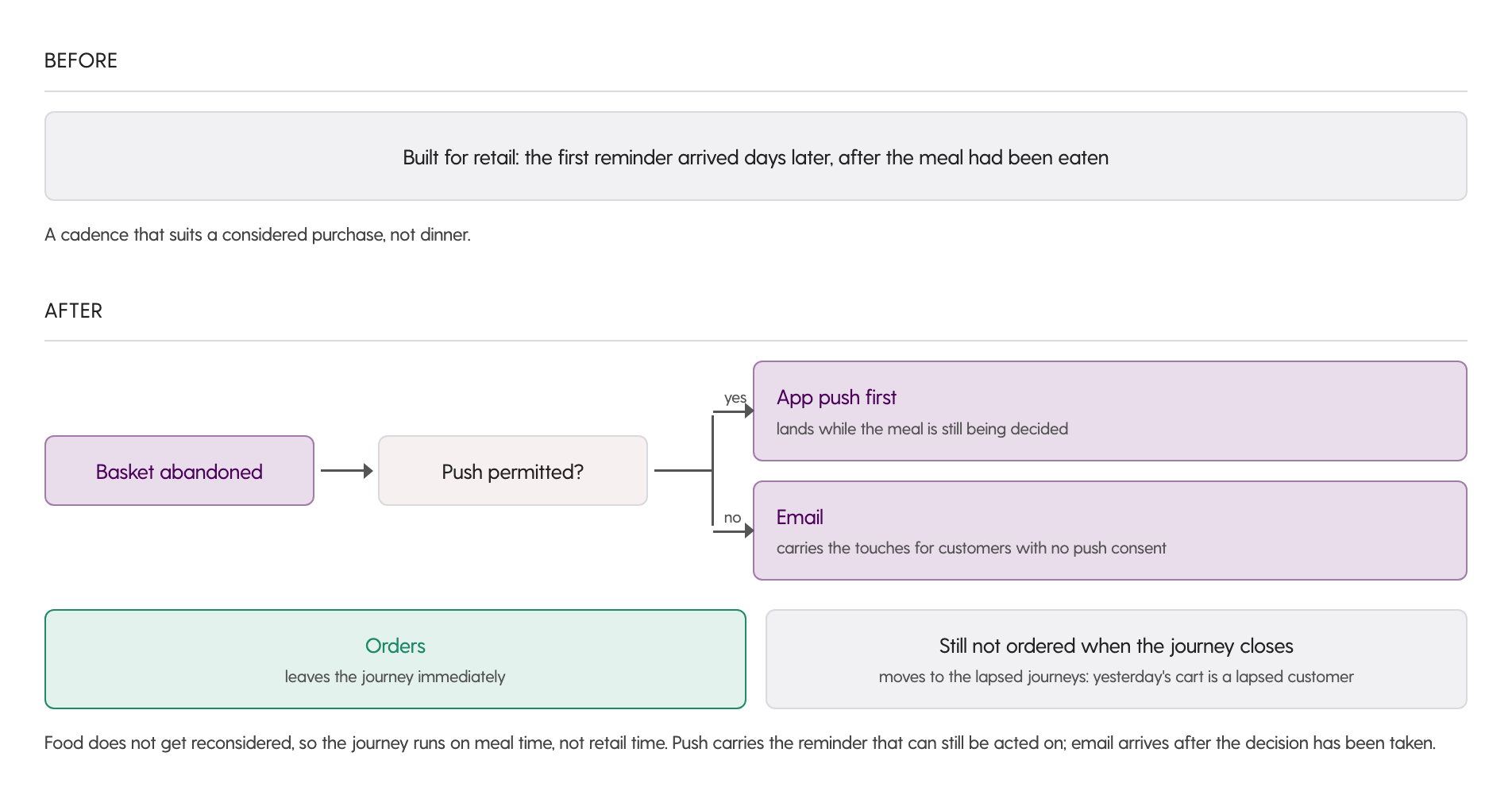
    The journey waited days before following up. That suits a considered purchase, not dinner. By the time the first reminder arrived, the meal had been eaten.
  3. The brand could reach far more people than it could recognise

    Reminders went out to large numbers of anonymous profiles alongside known members, and nothing on the website turned a browsing visitor into an identified one.

Key Objectives

  1. Segment dormancy by recency and by value
  2. Rebuild cart recovery on food timing
  3. Turn anonymous traffic into known customers

The Solution

  1. Audit every live journey before designing anything

    Eight journeys were live and almost none were segmented. The audit is how the retail cart cadence surfaced at all.
  2. Consent as a targeting input, not a checkbox

    Every journey branches on what each customer has permitted, so one person is reached by app push and another by email, and anybody unreachable is held back.
  3. The brand's own data made the case for identity

    Zero orders came from anonymous profiles, even though they opened and clicked the loyalty reminders at close to known-member rates. Known members on the same sends converted. Engagement without identity is a zero, and it is the clearest argument for turning unknown customers into known ones.

Seven Tiers From One Dormant Segment

The lapsed and dormant base was split by time since the last order, then the two deepest bands were split again by customer value. One segment became seven tiers, each running as its own journey with an exit the moment somebody orders.

The original plan put a voucher on every tier. The version that shipped took the voucher off the two freshest tiers completely and set the offer on every other tier separately.

Results:
the two tiers with no voucher drew the highest click-through of any tier
they also earned more between them than every voucher tier combined
the one deep tier that worked was the higher-value one, not the higher-discount one

Recency and customer value predicted reactivation. Discount depth did not. That reverses the read taken at the time, which credited the voucher with the revenue. Conversion was low on every tier, measured across the first seventeen days after launch.

Before and after of the lapsed segmentation: one dormant segment on a single offer, rebuilt into seven tiers ordered by time since the last order, with the two deepest bands split again by customer value. The two freshest tiers carry no voucher, and every other tier has its own offer.Before and after of the lapsed segmentation: one dormant segment on a single offer, rebuilt into seven tiers ordered by time since the last order, with the two deepest bands split again by customer value. The two freshest tiers carry no voucher, and every other tier has its own offer.
Channel selection diagram. A customer entering a tier is checked for which channels they have permitted, email, app push or web push, and is messaged only on those. Anyone with no permitted channel is held back, and anyone who orders leaves the journey immediately.Channel selection diagram. A customer entering a tier is checked for which channels they have permitted, email, app push or web push, and is messaged only on those. Anyone with no permitted channel is held back, and anyone who orders leaves the journey immediately.
No items found.
Before and after of cart recovery. Before: built for retail, with the first reminder arriving days later, after the meal had been eaten. After: an abandoned basket goes to app push first if the customer has permitted it, and to email if not. Anyone who orders leaves the journey immediately, and a basket still open when the journey closes moves to the lapsed journeys.
No items found.

Cart Recovery Rebuilt On Food Timing

Food does not get reconsidered. A basket abandoned at dinner has either been eaten elsewhere within the hour or stopped being a sale that evening. The journey was rebuilt to fire while the meal is still being decided, and to stop soon after. Anything older moves to the lapsed journeys, because yesterday's cart is a lapsed customer.

Channel order changed with it. App push carries a reminder that can still be acted on. Email arrives after the decision has been taken, so it carries the later touches for customers with no push consent.

Results:
roughly 9 in 10 of recovered cart revenue came through push rather than email
push click-through ran a little ahead of the journey it replaced

The old and new journeys did not run as a clean split test, since volumes were uneven and the changeover was phased, so we claim the channel split, not a revenue uplift. Cart recovery is the part of Pizza Hut's programme already earning, because the timing and the channel were wrong before and are right now.

No items found.

Results That Speak for Themselves

We focus on tangible outcomes—not just design for design’s sake. Here’s what our clients typically see after we launch or revamp their Shopify websites:
9 in 10
Of recovered cart revenue arrived through push rather than email
Zero
Orders from anonymous profiles, at known-member engagement rates
Better user experience = better results across sales and marketing performance, including higher ROAS for ad campaigns.

The Challenges

  1. Dormancy meant everything, so it meant nothing

    Every customer who had stopped ordering sat in one segment, whether they had missed a single month or had not ordered in over a year. They all got the same message and the same voucher.
  2. Cart recovery was built for retail

    The journey waited days before following up. That suits a considered purchase, not dinner. By the time the first reminder arrived, the meal had been eaten.
  3. The brand could reach far more people than it could recognise

    Reminders went out to large numbers of anonymous profiles alongside known members, and nothing on the website turned a browsing visitor into an identified one.

Key Objectives

  1. Segment dormancy by recency and by value
  2. Rebuild cart recovery on food timing
  3. Turn anonymous traffic into known customers

The Solution

  1. Audit every live journey before designing anything

    Eight journeys were live and almost none were segmented. The audit is how the retail cart cadence surfaced at all.
  2. Consent as a targeting input, not a checkbox

    Every journey branches on what each customer has permitted, so one person is reached by app push and another by email, and anybody unreachable is held back.
  3. The brand's own data made the case for identity

    Zero orders came from anonymous profiles, even though they opened and clicked the loyalty reminders at close to known-member rates. Known members on the same sends converted. Engagement without identity is a zero, and it is the clearest argument for turning unknown customers into known ones.

Seven Tiers From One Dormant Segment

The lapsed and dormant base was split by time since the last order, then the two deepest bands were split again by customer value. One segment became seven tiers, each running as its own journey with an exit the moment somebody orders.

The original plan put a voucher on every tier. The version that shipped took the voucher off the two freshest tiers completely and set the offer on every other tier separately.

Results:
the two tiers with no voucher drew the highest click-through of any tier
they also earned more between them than every voucher tier combined
the one deep tier that worked was the higher-value one, not the higher-discount one

Recency and customer value predicted reactivation. Discount depth did not. That reverses the read taken at the time, which credited the voucher with the revenue. Conversion was low on every tier, measured across the first seventeen days after launch.

Before and after of the lapsed segmentation: one dormant segment on a single offer, rebuilt into seven tiers ordered by time since the last order, with the two deepest bands split again by customer value. The two freshest tiers carry no voucher, and every other tier has its own offer.Before and after of the lapsed segmentation: one dormant segment on a single offer, rebuilt into seven tiers ordered by time since the last order, with the two deepest bands split again by customer value. The two freshest tiers carry no voucher, and every other tier has its own offer.
Channel selection diagram. A customer entering a tier is checked for which channels they have permitted, email, app push or web push, and is messaged only on those. Anyone with no permitted channel is held back, and anyone who orders leaves the journey immediately.Channel selection diagram. A customer entering a tier is checked for which channels they have permitted, email, app push or web push, and is messaged only on those. Anyone with no permitted channel is held back, and anyone who orders leaves the journey immediately.
No items found.

Interested in working with us?

Book a 30-minute discovery call with us and find you best quotation.

Book a Call

More of Our Works

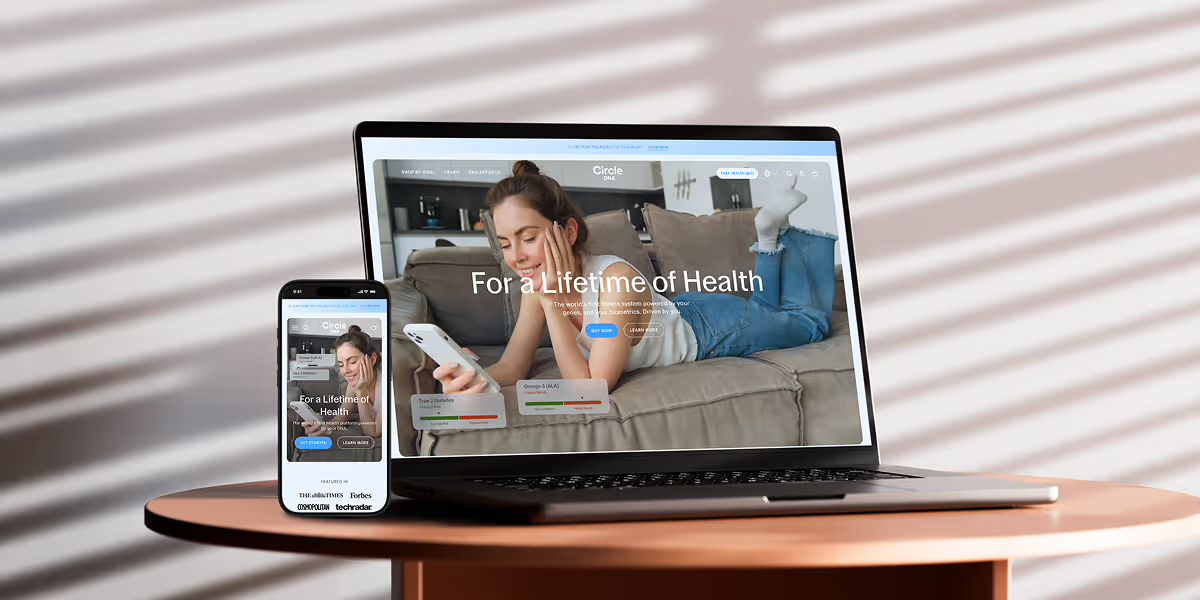
Circle DNA Website Mockup for Mobile and Desktop

CircleDNA

Revamped website to boost conversions & refresh brand identity.
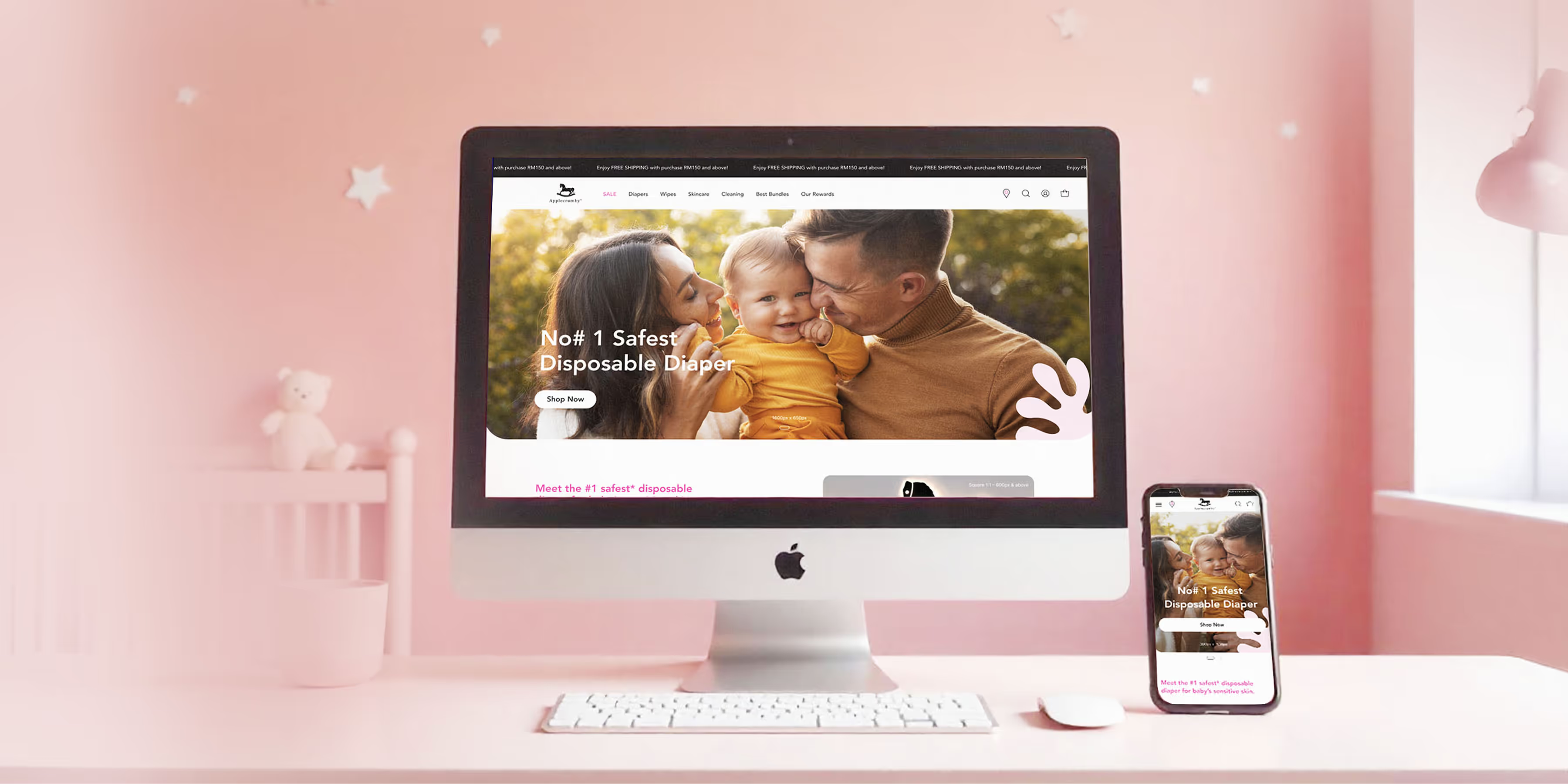
Applecrumby E-commerce Website Built Mockup for Mobile and Desktop

Applecrumby

Strengthened brand storytelling to boost customer conversions.
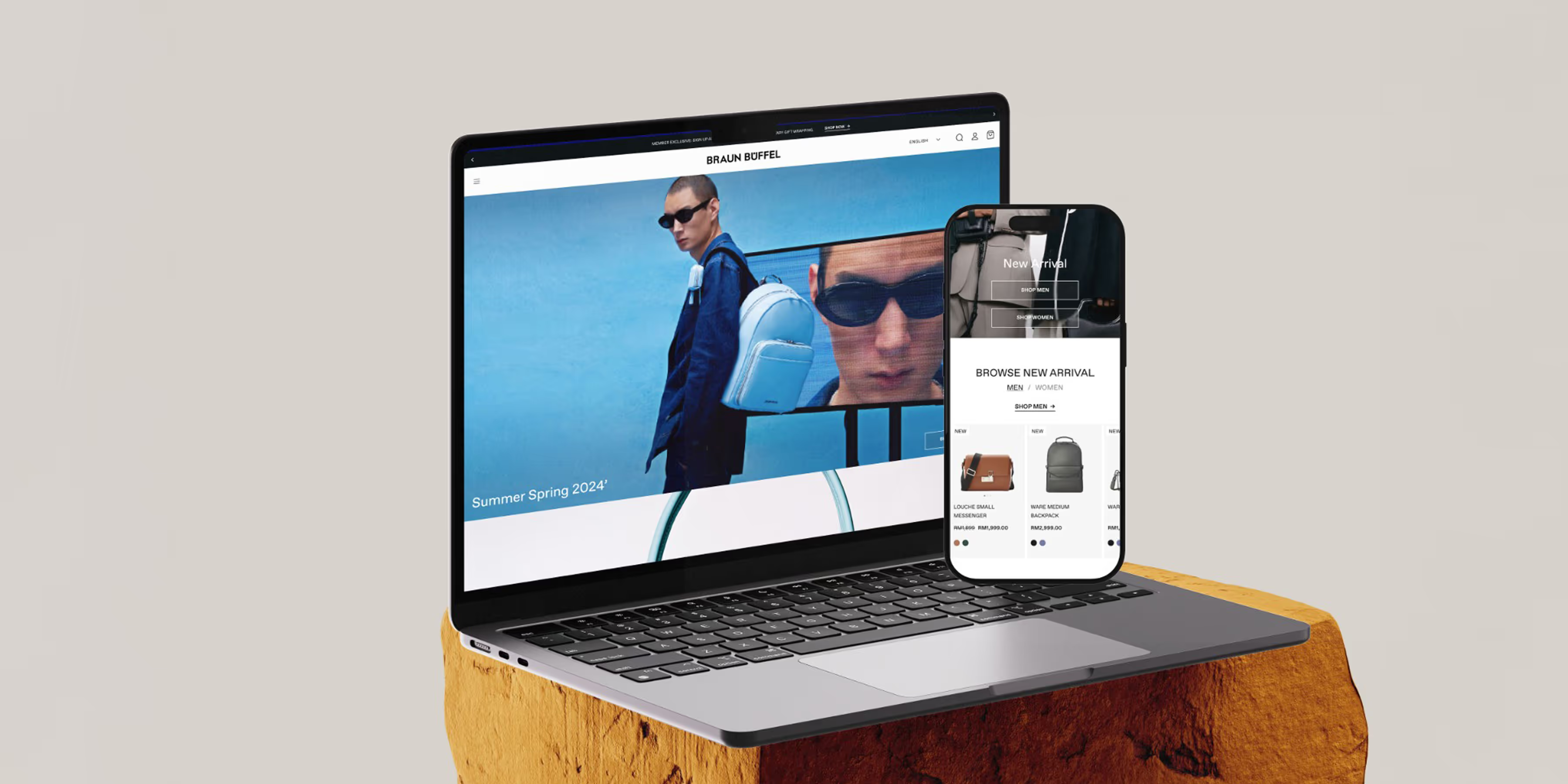
Braun Buffel Website Development Mockup for Mobile and Desktop

Braun Buffel

Strengthened brand and boosted conversions with strategic design.
Circle DNA Website Mockup for Mobile and Desktop

Oxwhite

Driving +25% AOV: Strategic UX and navigation for a minimalist lifestyle leader.
Circle DNA Website Mockup for Mobile and Desktop

Nattome

Boosting Conversions by +40%: An education-first Shopify revamp for a natural health leader.
Circle DNA Website Mockup for Mobile and Desktop

Chuck's

Scaling Sales by +89%: Transforming the storefront and UX hierarchy of a bold beauty disruptor.

Check Out @conversiondaryl

Roasting and fixing e-commerce websites, offering valuable marketing insights from a professional's perspective.

Pizza Hut Malaysia

Pizza Hut Malaysia takes orders through its own app and website, and its loyalty programme carries a very large customer base. All of that customer data sat in Netcore, a customer data platform the brand was already running. Convx by Z21 ran the layer above it: lifecycle strategy, segmentation, journey design and creative, with the platform team building to our specification.

Get a Free 30-Minute Consultation

Thank you! Your submission has been received!
Oops! Something went wrong while submitting the form.